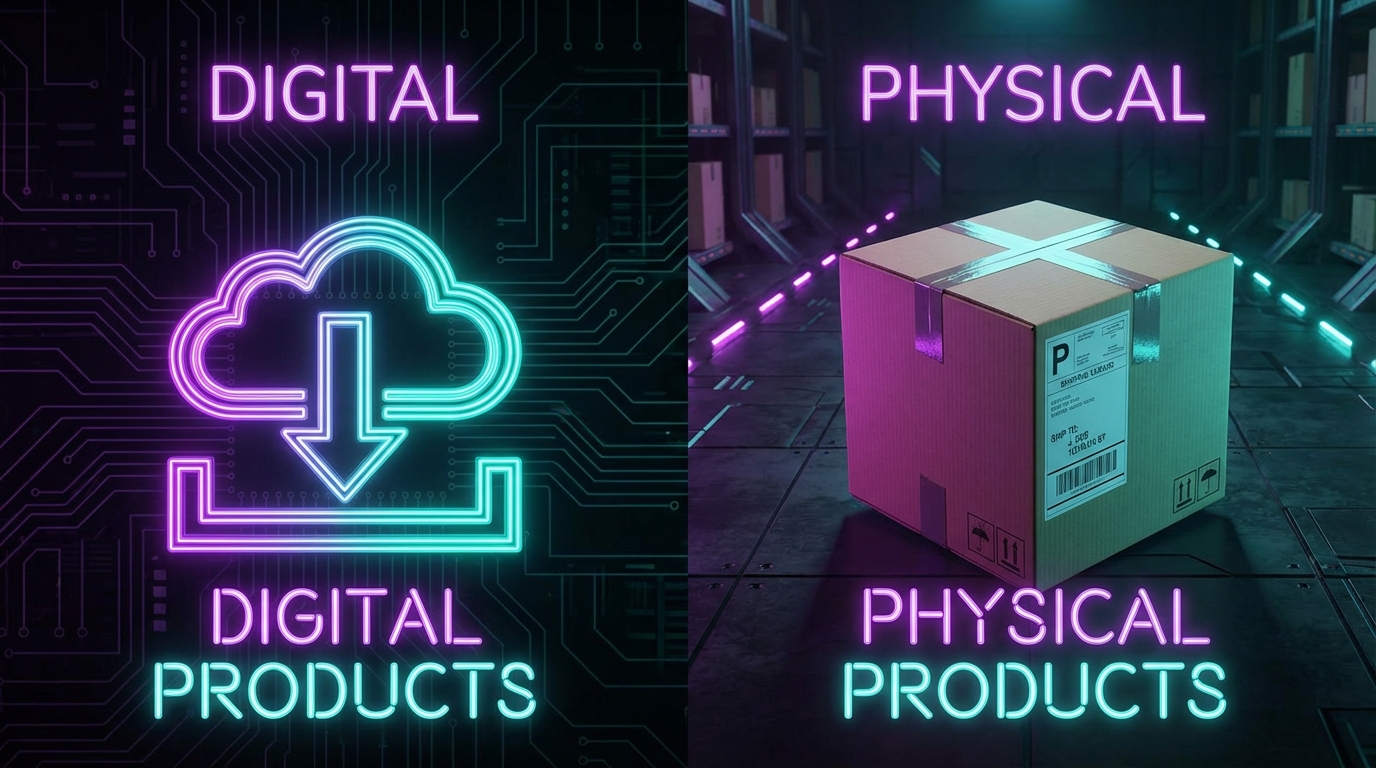
Every new online seller faces this fork in the road: go physical or go digital? It's not a simple answer — both models have routes to serious money, and both have failure modes that kill most people's income. Here's the real comparison based on what we've actually done.
The Core Difference: What You're Actually Selling
Physical products — even print-on-demand ones — involve a supply chain. A customer buys, something gets made and shipped, problems can occur, returns happen, shipping delays create complaints. There's friction inherent to moving atoms.
Digital products have zero supply chain. Customer buys, file downloads, done. No shipping, no inventory, no stock-outs, no production delays. The only friction is the creation of the product itself.
That fundamental difference cascades through every business metric: margin, scalability, customer support burden, platform risk, and income ceiling.
Margin Comparison: The Numbers Don't Lie
Let's run the numbers on a $25 sale for both models.
Physical product (POD mug via Printify + Etsy):
- Sale price: $25.00
- Printify production cost: ~$8.50
- Shipping (included in price): ~$5.00
- Etsy transaction fee (6.5%): $1.63
- Etsy listing fee: $0.20
- Etsy payment processing: $0.25 + 3%: ~$1.00
- Net profit: ~$8.67 (35% margin)
Digital product (printable planner via Etsy):
- Sale price: $10.00
- Production cost: $0
- Etsy transaction fee (6.5%): $0.65
- Etsy listing fee: $0.20
- Etsy payment processing: ~$0.55
- Net profit: ~$8.60 (86% margin)
They're earning roughly the same dollar amount per sale — but digital is half the price and earns the same. That means digital products can convert twice as many buyers at the same revenue. Or charge the same price and pocket double the profit.
💡 The real math: A digital product at $25 would net ~$20.60 — compared to $8.67 for a physical product at the same price. That's 2.4x the profit on the same transaction. Scale that over 1,000 sales and you're looking at $20,600 vs $8,670.
Scalability: Where Digital Wins Decisively
One of the most important properties of a business is whether it scales without proportional cost increases. Digital products are the ultimate example of this.
Create a digital planner once. Spend 6 hours building it. Then sell it 10,000 times. Your cost per unit drops toward zero. Your margin approaches 97%. There's no "we ran out of stock" problem. No supplier capacity constraints. No shipping rate increases eating your margin.
Physical products don't scale the same way. POD removes the inventory problem, but you're still paying per unit for every sale. Your 10,000th mug costs the same to produce as your first. Margins don't improve with volume unless you switch away from POD to bulk manufacturing — and that requires investment, warehousing, and operational complexity.
Where Physical Products Win: Conversion and Average Order Value
Physical products have a conversion advantage that's hard to deny. People understand what they're getting. "Funny mug for my mum" is an easy gift purchase — tangible, giftwrappable, feels like real value. Digital downloads require more explanation and trust, especially for buyers unfamiliar with instant downloads.
Average order value also skews higher for physical. A single personalised hoodie can sell for $55-70. Digital files rarely command that price point unless they're comprehensive (full course, premium template bundle). Most digital products price between $5-30.
Physical products also benefit from gift-buying behaviour, which drives a significant portion of Etsy's volume — particularly around Christmas, Mother's Day, and Valentine's Day. Digital files don't gift wrap.
Competition: The Uncomfortable Truth About Digital
Because digital products have no fulfillment cost, they attract more competition. The barrier to listing a $5 printable is almost zero. Popular digital categories on Etsy — printable planners, wall art, wedding invites, resume templates — are saturated with thousands of sellers.
This creates a paradox: higher margins, but you need better SEO and more differentiation to stand out. The digital sellers who make serious money have usually found a specific niche where demand exceeds supply, or they've built a catalogue of 100+ products so that the aggregate traffic drives consistent sales.
Customer Support: Where Physical Products Are a Burden
Physical products generate more support tickets. Production errors, shipping delays, wrong item delivered, items arriving damaged — each of these requires human intervention. In a POD model you're partially insulated (Printify handles production disputes), but you're still the face of the shop.
Digital products have their own support quirks — "I can't open the file" or "this doesn't look right when I print it" — but the volume and complexity is far lower. An Etsy shop with 100 digital sales a month might get 2-3 support queries. The same volume in physical products could generate 8-10.
Which Model Should You Start With?
Honest answer: it depends on your strengths.
- Start with physical (POD) if: You're new to Etsy, you want faster initial sales validation, you're not confident in graphic design skills, or you want to target gift-buying occasions.
- Start with digital if: You have strong design skills, you're comfortable with longer time-to-first-sale, you prioritise margin over volume, or you want a fully hands-off business long-term.
The optimal play, which we're pursuing, is both — use physical POD to generate early cash flow and Etsy algorithm trust, then layer in digital products to improve overall shop margins as volume grows. The shops with the most sustainable Etsy income have a mix.
The Long Game
At scale, digital wins on economics. But most sellers don't get to scale without first building an audience and a track record — and physical products, with their higher conversion rates and lower trust barrier, often get you there faster.
Start where you can execute fastest. Add the other model once you have traction. Don't let the perfect be the enemy of the first listing.
Start Your POD Store Today
Printify connects to Etsy in minutes. Free to start, no monthly fee.
Get Printify Free →