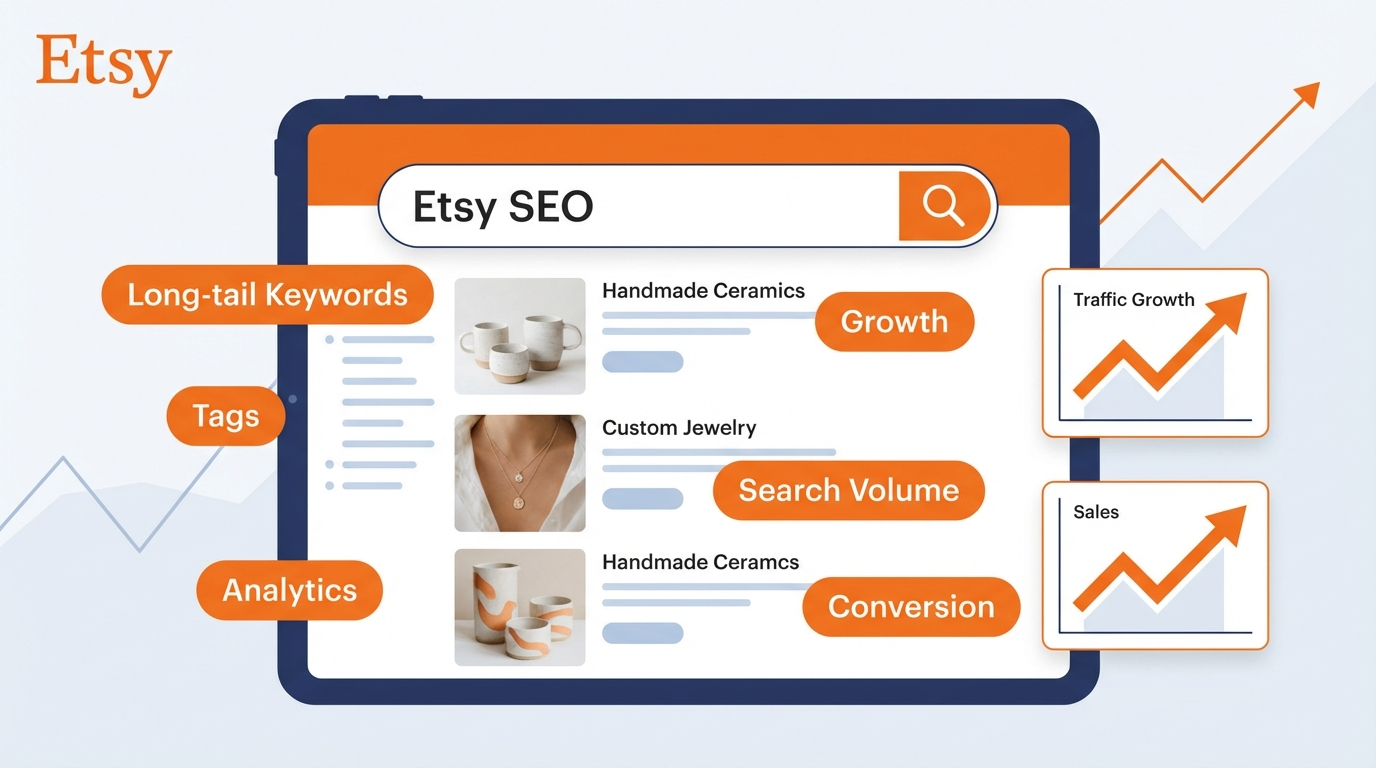
Getting traffic on Etsy in 2026 comes down to two things: search ranking (SEO) and paid visibility (Etsy Ads). Master both and you have a predictable, scalable sales machine. Ignore them and your listings sit on page 47 where nobody will ever find them. Etsy has over 90 million active buyers. The traffic is there. Your job is to put your products in front of them.
This guide covers the exact Etsy SEO and Ads strategies that top sellers use in 2026 to generate consistent sales. No theory, no fluff — just the tactics that move the needle.
📌 Key stat: 88% of Etsy purchases start with a search. If your listings are not optimized for the right keywords, you are invisible to 88% of potential buyers. Sellers who optimize their SEO see an average 30-60% increase in organic traffic within 60 days.
Etsy SEO Fundamentals: How the Algorithm Works in 2026
Etsy's search algorithm (known as the Etsy search ranking system) determines which listings appear when a buyer searches. Understanding how it works is the foundation of everything else.
The algorithm considers these factors in order of importance:
- Query matching: Does your listing contain the exact words the buyer searched? This is controlled by your title, tags, categories, and attributes.
- Listing quality score: How well does your listing convert? Click-through rate, add-to-cart rate, and purchase rate all feed this score. Better photos and competitive pricing improve quality score.
- Recency: New listings get a temporary boost. This is why consistent listing creation (or renewing) keeps your shop visible.
- Shop quality: Your overall shop score based on reviews, shipping times, response rates, and policy compliance.
- Relevancy: How well does your product match the buyer's intent? Etsy uses machine learning to understand what buyers actually want when they search.
The takeaway: SEO gets you in front of buyers. Listing quality determines whether you stay there. Both matter.
Keyword Research for Etsy (The Right Way)
Keyword research on Etsy is different from Google SEO. Etsy keywords are product-focused and purchase-intent heavy. Someone searching "minimalist wall art print" on Etsy is ready to buy. Someone searching the same on Google might just be browsing.
Method 1: Etsy Search Autocomplete
Start typing a broad keyword in the Etsy search bar and note every autocomplete suggestion. These are real searches by real buyers. "Personalized gift" might autocomplete to "personalized gift for mom," "personalized gift boyfriend," "personalized gift teacher," etc. Each variation is a potential keyword to target.
Method 2: eRank or Marmalead
These are Etsy-specific keyword tools that show search volume, competition, and click rates for keywords on the platform. eRank's free tier is surprisingly powerful. Look for keywords with high search volume and moderate competition. Avoid ultra-competitive terms where established shops dominate page one.
Method 3: Competitor Analysis
Find top-selling listings in your niche and study their titles, tags, and descriptions. What keywords are they targeting? What long-tail variations are they using? Tools like EverBee show estimated monthly sales for any Etsy listing, so you can identify which keywords actually drive revenue.
Method 4: Google Trends + Etsy
Check Google Trends for seasonal and trending keywords related to your products. "Graduation gift" spikes every May. "Christmas ornament personalized" starts climbing in September. Timing your SEO around seasonal demand is a massive advantage on Etsy.
Optimizing Your Etsy Listings for Search
Titles (Most Important SEO Element)
Your title gets 140 characters. Use every single one. Front-load with your primary keyword. Structure: Primary keyword | Secondary keyword | Tertiary keyword | Descriptive details.
Example: "Personalized Dog Portrait Custom Pet Painting From Photo Digital Download Wall Art Gift for Dog Lover Pet Memorial"
Every word in that title is a searchable keyword or keyword phrase. Do not waste title space on your shop name, item numbers, or phrases like "best quality" that nobody searches for.
Tags (13 Tags Per Listing)
You get 13 tags of up to 20 characters each. Use all 13. Each tag should be a unique keyword phrase that buyers actually search. Do not repeat words already in your title — Etsy already indexes your title. Use tags to capture additional search terms.
Tag strategy:
- 3-4 broad keywords (high volume)
- 5-6 medium-tail keywords (moderate volume, less competition)
- 3-4 long-tail keywords (low volume but high conversion)
Example for a digital planner: Tags might include "digital planner 2026," "GoodNotes planner," "iPad planner," "weekly planner PDF," "productivity planner," "work planner template," "student planner digital," etc.
Categories and Attributes
Select the most specific category possible. If you sell a watercolor landscape print, do not just select "Art" — select "Art > Prints > Digital Prints > Landscape." Attributes (color, size, style) further refine your listing's relevancy signal. Fill out every available attribute field.
Description (Secondary SEO Impact)
Etsy's algorithm does index descriptions, but they carry less weight than titles and tags. Still, write descriptions that naturally include relevant keywords in the first 2-3 sentences. The description's primary job is converting browsers to buyers, so focus on benefits, features, and what the buyer gets.
Listing Photos That Convert
SEO gets clicks. Photos close the sale. Your first photo is your thumbnail — it determines whether someone clicks on your listing from search results. The rest of your photos determine whether they buy.
Photo Best Practices for 2026
- First image: Clean, bright, zoomed-in shot of the product. White or light background. The product should fill at least 70% of the frame. This is your billboard in search results.
- Image 2-3: Lifestyle/context shots. Show the product in use or in a realistic setting. A wall art print shown hanging in a living room. A planner shown on a desk with a coffee cup.
- Image 4-5: Detail shots. Close-ups of quality, texture, or unique features. Show what makes your product different.
- Image 6-7: Size reference, packaging, or variations. Help the buyer visualize what they are actually receiving.
- Image 8-10: Customer photos, testimonials as images, or comparison charts. Social proof closes the deal.
Use all 10 image slots. Listings with 10 images statistically outperform listings with fewer images in both click-through rate and conversion rate.
Etsy Ads: When and How to Use Them
Etsy Ads put your listings at the top of search results for a fee. They are a powerful accelerator, but only if your listings are already optimized. Running ads on a poorly optimized listing is like pouring water into a bucket with holes.
When to Start Etsy Ads
Start advertising only after you have:
- At least 20-30 active listings
- Professional photos on every listing
- Optimized titles and tags
- At least a few sales and reviews (social proof)
- Competitive pricing in your niche
Advertising unoptimized listings wastes money. Fix the fundamentals first.
Setting Your Budget
Start with $1-$5/day. Etsy Ads use a cost-per-click model where you compete in an auction with other sellers. The minimum daily budget is $1. At $5/day, you get enough data to see which listings perform and which do not. Run ads for at least 30 days before making judgments — the algorithm needs time to optimize.
Which Listings to Advertise
Not all listings deserve ad spend. Advertise listings that:
- Already have organic sales (proven demand)
- Have strong click-through rates (good photos)
- Have healthy margins (can absorb 15-25% ad cost)
- Are in competitive categories where organic ranking is hard
Turn off ads on listings with low margins, poor conversion rates, or categories where you already rank on page one organically.
Measuring Ad Performance
The key metric is ROAS (Return on Ad Spend). Calculate: total revenue from ads / total ad spend. A ROAS of 3x or higher is good (you earn $3 for every $1 spent). Below 2x, you are likely losing money after product costs and fees.
Check Etsy Ads analytics weekly. Identify your top-performing listings (high ROAS) and increase their daily budget. Pause underperforming listings (ROAS below 2x) and fix their SEO, photos, or pricing before reactivating.
💡 Pro tip: Etsy Ads work best for seasonal products. Ramp up ad spend 4-6 weeks before peak buying seasons (Christmas, Valentine's Day, Mother's Day, graduation season). The cost per click is higher during peaks, but so is buyer intent and average order value.
Advanced Etsy SEO Strategies for 2026
The Multi-Listing Strategy
Create multiple listings targeting different keyword variations of the same product. A digital planner could have separate listings optimized for "GoodNotes planner 2026," "iPad digital planner," "minimalist weekly planner," and "ADHD planner template." Each listing captures a different search audience. This is standard practice for top Etsy sellers.
Seasonal Keyword Rotation
Update your titles and tags quarterly to match seasonal search trends. In March, add "Easter gift" and "spring decor" keywords. In October, add "Halloween" and "fall themed." Products that can be positioned for multiple seasons get consistent year-round traffic instead of one-time spikes.
Internal Linking Through Shop Sections
Organize your shop into clear sections. When buyers find one product they like, sections guide them to related items. More page views per visit improve your shop quality score and increase average order value. Use section names that are keyword-rich: "Personalized Pet Gifts" instead of "Section 1."
Review Velocity
Reviews are a ranking factor. More reviews (especially 5-star reviews) improve your listing quality score. Follow up with every buyer through Etsy's messaging system (not external email) with a polite thank-you and gentle review request. Include a message card in physical shipments asking for reviews. A shop with 500 reviews ranks better than a shop with 50, all else being equal.
External Traffic Bonus
Etsy gives a ranking boost to listings that drive traffic from external sources (Pinterest, Google, social media). This means your off-Etsy marketing directly improves your on-Etsy SEO. Pinterest is the single best external traffic source for Etsy. Pin every listing with keyword-rich descriptions.
Common Etsy SEO Mistakes
Keyword stuffing: Repeating the same keyword in titles and tags does not help. Etsy counts each unique word once. Use your 13 tags to capture 13 different keyword phrases, not 13 variations of the same phrase.
Ignoring long-tail keywords: "Wall art" has massive competition. "Boho nursery wall art set of 3" has far less competition and higher purchase intent. Long-tail keywords are where new sellers win.
Poor first photo: Your thumbnail is your ad. A dark, blurry, or cluttered first photo kills your click-through rate, which tanks your listing quality score, which drops your search ranking. It is a death spiral. Invest time in your first photo above all else.
Set-and-forget listings: SEO is not a one-time task. Review your stats monthly. Which listings get views but not sales? Improve their photos or pricing. Which listings get no views? Rewrite their titles and tags. The sellers who consistently optimize outperform the sellers who list and forget.
Competing on price alone: Racing to the bottom on pricing attracts the worst customers and destroys your margins. Compete on presentation, perceived value, and customer experience instead.
The Complete Etsy Growth Flywheel
- Research: Find profitable keywords with moderate competition
- Optimize: Create listings with keyword-rich titles, all 13 tags, and professional photos
- Launch: New listings get a recency boost — capitalize on it
- Advertise: Run Etsy Ads on your best-performing listings
- Drive external traffic: Pin to Pinterest, share on social media
- Collect reviews: Follow up with buyers, request reviews
- Analyze: Review stats monthly, optimize underperformers
- Scale: Add more listings targeting new keyword opportunities
- Repeat: The flywheel accelerates with every cycle
Sellers who run this flywheel consistently for 6-12 months build shops that generate $2,000-$20,000+/month. It is not magic. It is systematic execution of proven tactics.
Revenue Expectations
- Month 1-3 (Foundation): 30-50 listings, first sales trickling in. Revenue: $100-$500/month.
- Month 3-6 (Growth): 50-100 listings, SEO compounding, reviews building. Revenue: $500-$2,000/month.
- Month 6-12 (Scale): 100-200 listings, ads running, external traffic flowing. Revenue: $2,000-$8,000/month.
- Year 2 (Established): 200+ listings, strong review base, brand recognition. Revenue: $5,000-$20,000+/month.
Start Optimizing Today
If you already have an Etsy shop, go through every listing this week and optimize titles and tags using the strategies above. If you are starting fresh, create your first 10 listings with proper SEO from day one. The sellers who win on Etsy in 2026 are not the most talented — they are the most consistent at optimizing, listing, and improving.
For more Etsy strategies, check out our guides on best Etsy digital downloads in 2026 and our EverBee review for Etsy research.