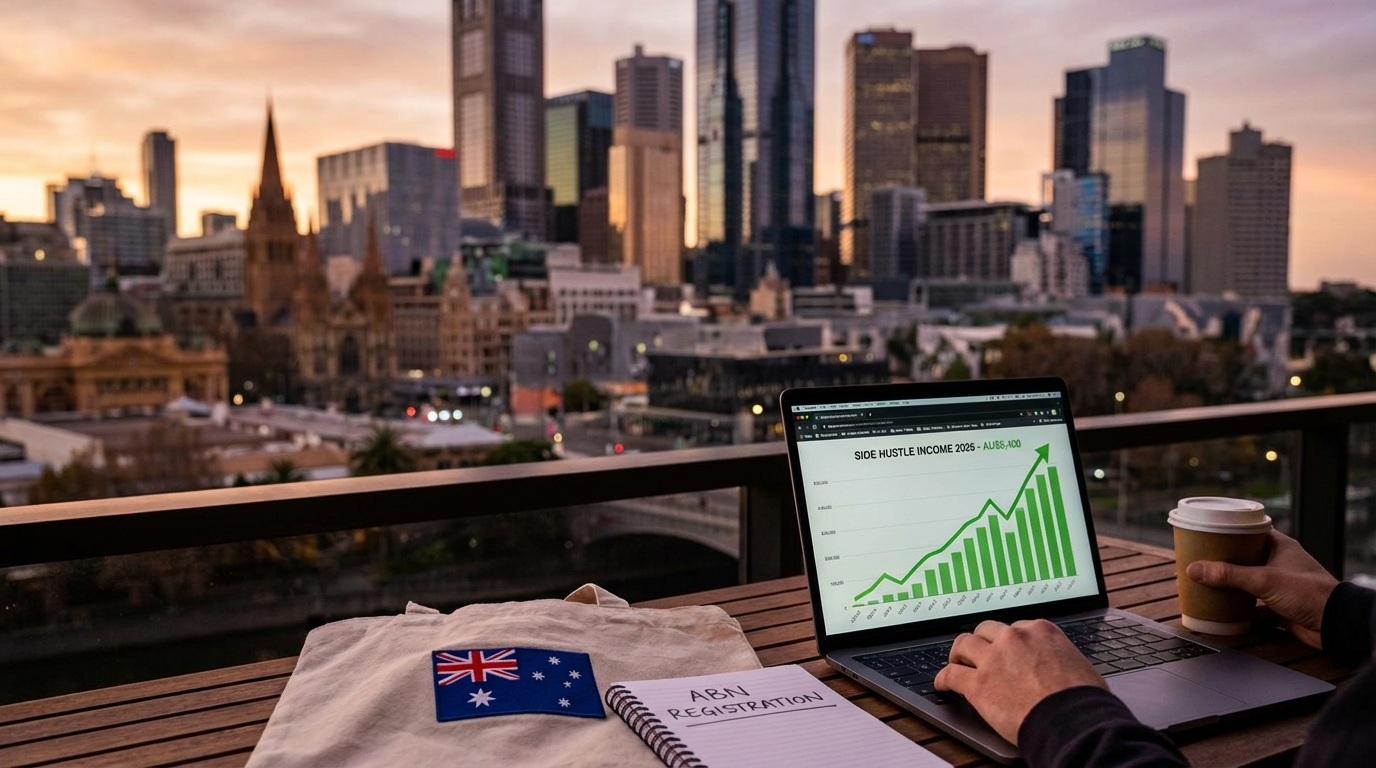
Most side hustle content online is written for Americans. The platforms, the tax advice, the payment processors — all US-centric. As someone building online income from Sydney, I've had to figure out a lot of this the hard way. This article covers what actually applies in Australia and what doesn't.
Quick context: I'm Ian. I run a construction business as a director, collect and sell trading cards, and I'm now building an AI-assisted content and print-on-demand operation with Jeff. All of this while managing a full-time income. Here's what I know from actually doing it.
Do You Need an ABN?
This is the first question every Australian asks, and the answer is: probably yes, and it's free to get.
An Australian Business Number (ABN) is required if you're running a business or enterprise in Australia. The ATO's definition of "business" includes: intention to make a profit, regular activity, and a commercial scale of operations. A casual one-off sale on eBay doesn't require an ABN. A consistent Etsy store or affiliate marketing operation does.
Key rule: Once your taxable earnings from a side business exceed $75,000/year, you must register for GST. Below that threshold, GST registration is optional but ABN registration is still strongly recommended for any consistent income-generating activity.
Register at the ATO's ABR (Australian Business Register) portal — abr.gov.au. Takes about 20 minutes. It's free. Do it before you start earning.
Tax: The Honest Truth
Side hustle income is taxable income in Australia. Full stop. Every dollar you earn from Etsy, affiliate links, Fiverr gigs, or digital products gets added to your taxable income and taxed at your marginal rate.
The good news: legitimate business expenses are deductible. If you're paying for Canva, Printify, Jasper, web hosting, a laptop used for the business, or a portion of your phone bill — these are potentially deductible expenses that reduce your taxable income.
Practical setup I use:
- Separate bank account for side hustle income and expenses
- Spreadsheet tracking all income and categorised expenses monthly
- Save 30% of side hustle earnings in a separate savings account for tax time
- Keep all receipts for business expenses (Xero or even a simple Google Drive folder works)
If you're earning over $20,000/year from a side hustle, talk to an accountant. The cost of an hour of advice saves more in tax optimisation than it costs.
⚠️ ATO awareness: The ATO has significantly improved its data-matching capabilities. Etsy, PayPal, eBay, and most major platforms report Australian transaction data. Don't assume income under a certain threshold is invisible — declare it.
Best Side Hustles for Australians in 2026
What works in Australia isn't always the same as what works in the US, for a few reasons: smaller local market, higher shipping costs, and different platform dynamics. Here's my honest ranking:
1. Print on Demand (Etsy-focused)
This works well for Australians specifically because POD ships globally — your market isn't limited to Australia's 26 million people. You're selling to Americans, Europeans, and Brits who don't care where you're based. Printify has Australian print providers now too, which helps with domestic shipping times.
The challenge: many popular POD products have base costs that are higher when shipping from Australia to the US. Use Printify's US-based print providers for your US listings. Use local providers for Australian sales.
2. Digital Products
Zero shipping, zero inventory, instant delivery. Canva templates, digital planners, printable downloads, prompt packs, eBooks. Etsy is great for digital products — it handles the delivery automatically. Margins are essentially 100% minus platform fees (except transaction costs).
An Australian advantage here: if you're in a professional field (construction, nursing, law, education), there are underserved niche digital product markets that American sellers haven't dominated yet.
3. Freelancing via Fiverr / Upwork
The exchange rate works in your favour as an Australian seller on global platforms — you're earning USD, AUD has been weak. A $500 USD project becomes $760+ AUD at current rates. If you have a marketable skill (copywriting, graphic design, social media management, video editing, accounting), this is the fastest path to side hustle income.
Fiverr is the easier starting platform. Set up a profile, create clear gig descriptions, price competitively at the start to get reviews, then raise rates.
4. Affiliate Marketing / Content Sites
Slowest to pay off but highest ceiling. An Australian-focused niche site (home improvement, finance, gardening, outdoor adventures) can earn through Australian affiliate programs — CommBank, Woolworths, Bunnings, and every major Australian retailer has an affiliate program via Commission Factory or Impact.
Commission Factory is the main Australian affiliate network. Sign up, browse their merchant list (500+ Australian brands), and integrate links into relevant content.
5. Trading Cards / Collectibles
This is personal for me. I've built a consistent secondary income selling Pokemon and One Piece cards at conventions and on eBay. Australia has a passionate and growing collector community, and the convention circuit is expanding. It's not purely online, but eBay sales are.
Capital-intensive to scale, knowledge-intensive to do well, but margins are excellent when you source correctly. Not for everyone, but worth mentioning because it's working for me.
Payment Processors: What Works in Australia
The US-centric options that don't work well for Australians:
- Stripe: Works in Australia, but you'll need an Australian business bank account. Strongly recommended.
- PayPal: Universal. High fees. Use for selling but don't hold large balances.
- Wise (formerly TransferWise): Essential if you're earning in USD and want to receive at good exchange rates. Best-in-class for international transfers.
- Payoneer: Alternative to Wise, commonly used for Fiverr and Upwork withdrawals.
For Etsy specifically: Etsy Payments handles the customer transaction and pays out in AUD to your nominated Australian bank account. Straightforward, no setup required beyond your bank details.
The Australia-Specific Advantage Nobody Talks About
Time zones. Working Sydney hours means you're awake when most of Europe and Asia are online, and you have quiet hours when the US market is sleeping — which means less competition for certain tasks. If you're doing client work or community-building in the Asia-Pacific market, you're in the right place. Most Americans building side hustles are competing in a saturated US-centric space.
The Australian market is also underserved for local, niche content. A Sydney-based home renovation blog, a Melbourne coffee culture YouTube channel, or an Australian-specific financial independence resource has less competition than its American equivalent and a loyal local audience that American creators can't authentically serve.
Where to Actually Start
My honest recommendation for an Australian with a full-time job and 10 hours/week:
- Register an ABN (20 minutes, free)
- Pick either POD on Etsy or a freelance service on Fiverr
- Set up a separate bank account for business income
- Commit to 90 days before evaluating results
Don't overthink the structure at the start. An ABN as a sole trader is fine until you're earning enough to warrant a company structure (usually $75K+ in net profit from the business). Keep it simple and get moving.
Start Your POD Store Today
Printify is free, ships to Australia and globally, and connects directly to Etsy. Best starting point for Australian POD sellers.
Get Printify Free →Related: Passive Income: Setting Real Expectations Before You Start →