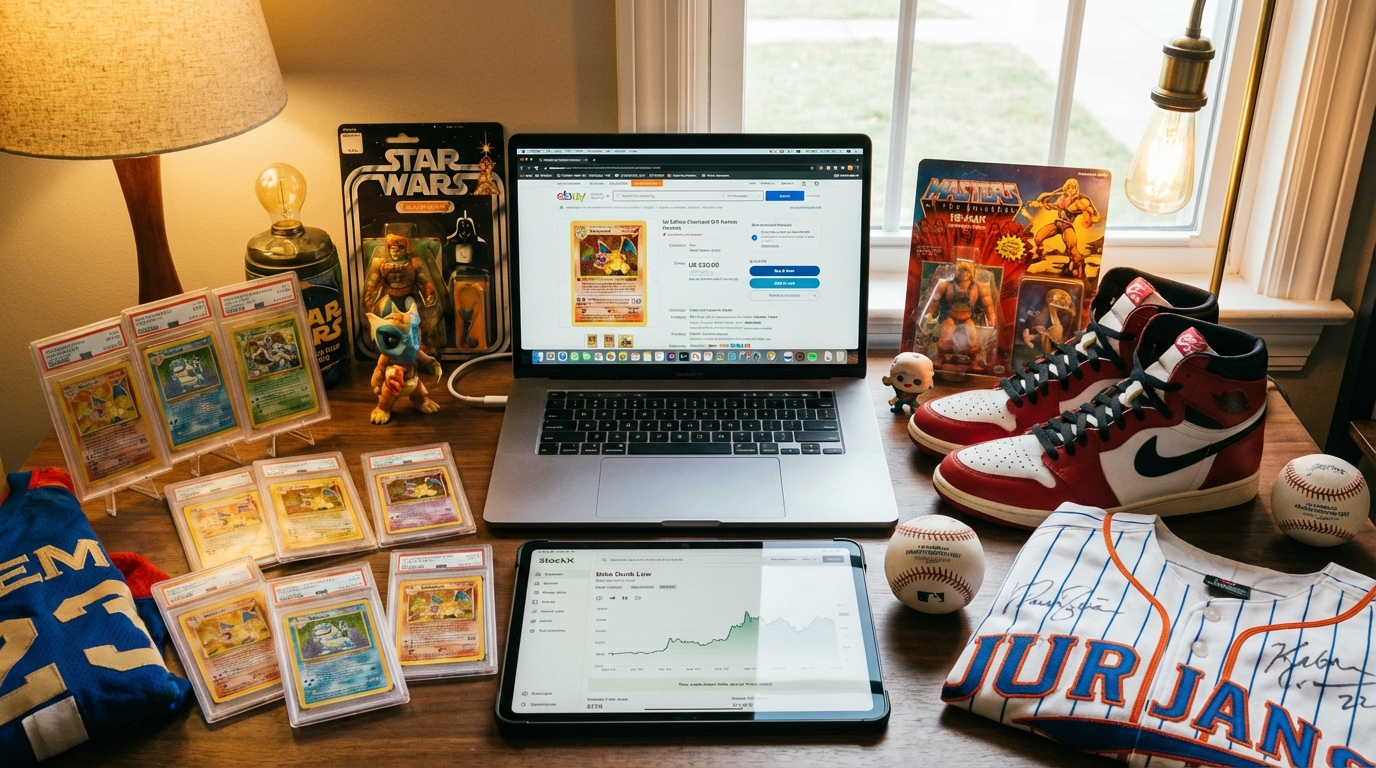
Reselling collectibles went from garage sale hobby to data-driven business. In 2026, people are earning $1,000 to $20,000+ per month flipping Pokemon cards, sports memorabilia, vintage toys, sneakers, and sealed product on platforms like eBay, Whatnot, and StockX. The entry barrier is low. You need a smartphone, some starting capital, and the willingness to learn what's actually worth money.
The collectibles market thrives on three things: scarcity, nostalgia, and authentication. Items that are rare, emotionally meaningful, and verifiably authentic command premium prices. Smart resellers exploit the gap between what sellers don't know their items are worth and what buyers are willing to pay. That arbitrage is where the money lives.
📌 Key stat: The global collectibles market hit $482 billion in 2025 and is growing 8-10% annually. Trading card sales alone exceeded $15 billion. eBay processed over $4 billion in collectibles transactions last year.
Most Profitable Collectible Categories in 2026
Pokemon and Trading Cards
Trading cards remain the hottest collectibles category. Pokemon cards alone generate billions in annual sales, with Japanese vintage cards and sealed product seeing the strongest appreciation. One Piece TCG is the fastest-growing game, with early sets commanding significant premiums.
Where the money is:
- Sealed booster boxes: Buy at retail ($150-$200), hold 6-12 months, sell for $250-$500+. Out-of-print boxes appreciate 30-100% annually.
- PSA graded cards: Buy raw cards cheaply, grade them at PSA ($20-$50 per card), sell graded copies at 2-5x markup. A raw card worth $30 might sell for $150 in PSA 10.
- Japanese cards: Source from Japan at 30-50% of Western retail prices. Buyers in US, UK, and Australia pay premium for Japanese exclusives.
- Convention flipping: Buy at card shows and conventions at wholesale/trade rates, sell online at full market value. Margins of 30-50% are common.
Vintage Toys and Action Figures
Star Wars, Transformers, LEGO, and vintage Nintendo items are evergreen categories. Sealed LEGO sets appreciate 10-15% annually on average, beating most stock market returns. Complete, boxed vintage toys from the 80s and 90s are in constant demand from adult collectors.
Sneakers and Streetwear
Limited-edition sneakers from Nike, Jordan, and Yeezy remain highly liquid assets. Platforms like StockX and GOAT have made sneaker reselling almost as easy as stock trading. Average margins are 20-40% on hyped releases, with some limited drops hitting 200-500% markup.
Sports Memorabilia
Autographed items, game-used equipment, and vintage sports cards remain strong performers. The key is authentication. Items authenticated by PSA, Beckett, or JSA command 2-5x premiums over unverified pieces.
Where to Source Collectibles Cheaply
The sourcing is where resellers make or break their margins. Here are the best channels in 2026:
- Facebook Marketplace and local groups: People sell inherited collections, garage cleanouts, and impulse purchases for pennies on the dollar. Set alerts for keywords like "Pokemon cards lot," "vintage toys," and "card collection."
- Estate sales and auctions: Estate sale apps like EstateSales.net list local sales. You'll find boxes of vintage cards, toys, and memorabilia that families don't know the value of.
- Thrift stores: Goodwill, Salvation Army, and local thrift shops regularly get donations of collectibles. The finds are inconsistent but the margins when you hit are enormous.
- Japanese wholesale: For cards, buying directly from Japanese distributors or during trips to Japan offers 40-60% savings over Western retail. Mandarake, Surugaya, and Card Rush are key sources.
- Retail arbitrage: Walmart, Target, and Costco regularly stock sealed product at MSRP. When sets go out of print, these retail purchases become worth 2-3x within months.
- Conventions and card shows: Buy at wholesale, trade rates (80-90% of market). Sell online at 100% market. The volume at conventions makes this consistently profitable.
Best Platforms for Selling Collectibles
eBay (Still King for Collectibles)
eBay dominates collectibles sales. The platform handles $4+ billion in collectibles annually and has the largest buyer pool. Fees are 13.25% on average (including payment processing), but the volume and trust make it worth it.
Tips: Use eBay's sold listings data to price accurately. Ship with tracking always. Get Top Rated Seller status for lower fees and better visibility. Auction format works for rare items; Buy It Now for commodity items.
Whatnot (Live Selling)
Whatnot revolutionized collectibles sales with live-stream auctions. Sellers go live, show items on camera, and buyers bid in real-time. The energy and FOMO of live auctions often push prices 10-30% above eBay comps. Fees are 8% + payment processing.
This is especially strong for cards, comics, and Funko Pops. Top Whatnot sellers earn $10,000-$50,000/month.
StockX and GOAT (Sneakers and Streetwear)
These platforms handle authentication, so buyers trust them. Fees are 9-10% for established sellers. The marketplace format (bid/ask like a stock exchange) means you can set your price and wait for a buyer to meet it.
TCGPlayer (Trading Cards)
The go-to platform for individual trading cards. Lower fees than eBay (around 11% for standard sellers) and a buyer audience that specifically wants cards. Excellent for moving single cards and small lots.
Data-Driven Reselling: How to Price Like a Pro
Amateur resellers guess at prices. Professionals use data. Here are the tools that give you an edge:
- eBay sold listings: The gold standard. Filter by "Sold Items" to see actual transaction prices, not asking prices. This is real market data.
- PriceCharting.com: Tracks historical prices for video games, trading cards, and collectibles. See trends over time to identify items that are appreciating.
- 130point.com: Free eBay sold data analysis. Shows average sale prices, sell-through rates, and price trends for any search term.
- StockX/GOAT price history: For sneakers and streetwear, these platforms show complete price history with charts. Time your sells around hype cycles.
- PSA Population Reports: For graded cards, check how many copies exist at each grade. Lower population = higher value. A PSA 10 with pop 5 is worth dramatically more than one with pop 500.
📌 Pro tip: Track your cost basis religiously. Use a spreadsheet or inventory app to log every purchase price, platform fees, shipping costs, and sale price. Many resellers think they're profitable but don't account for fees, packaging, and time. Know your real margins.
Getting Started: Week-by-Week Plan
- Week 1: Pick one category (cards, toys, sneakers). Study eBay sold listings for 2 hours. Learn what's worth money and what isn't. Join 3-5 Facebook groups for that category.
- Week 2: Source your first inventory. Start with $100-$300 budget. Hit thrift stores, Facebook Marketplace, and retail stores. Buy items you've verified have profitable comps.
- Week 3: List everything on eBay. Take clean photos (white background, good lighting), write detailed descriptions with relevant keywords, and price based on sold comps. Ship fast with tracking.
- Week 4: Analyze what sold, what didn't, and why. Reinvest profits into more inventory. Expand your sourcing channels. Consider getting set up on a second platform.
Common Mistakes to Avoid
- Buying what you like instead of what sells. Your personal taste doesn't matter. The market decides value. Follow the data.
- Overpaying for inventory. The profit is made at purchase, not sale. If you can't buy at 40-60% of market value, walk away.
- Ignoring condition. Condition is everything in collectibles. A near-mint item might be worth 5x a "good" condition copy. Learn grading standards for your category.
- Not accounting for fees. eBay takes 13%, shipping costs money, packaging costs money, your time costs money. Price accordingly or you'll be busy and broke.
- Holding too long. Some items appreciate. Most don't. If something hasn't sold in 90 days, lower the price or liquidate. Cash flow matters more than theoretical profit.
Realistic Income Timeline
- Month 1: Learning curve, first sales. Income: $100-$500 profit.
- Month 2-3: Better sourcing, faster selling. Income: $500-$2,000.
- Month 4-6: Established sourcing channels, repeat buyers, higher volume. Income: $1,000-$5,000.
- Month 6-12: Multiple platforms, wholesale relationships, possibly live selling. Income: $3,000-$15,000+.
The people making $10,000+/month treat this as a full business. They have dedicated storage, professional photography setups, and spend 20-40 hours per week sourcing, listing, and shipping. It scales with effort and capital.
If you're interested in more side hustle ideas, check out our guide on the best side hustles in 2026 or learn about making money on TikTok.
Want weekly guides on building online income?
Real breakdowns, real numbers, zero fluff. Join 3,000+ readers.