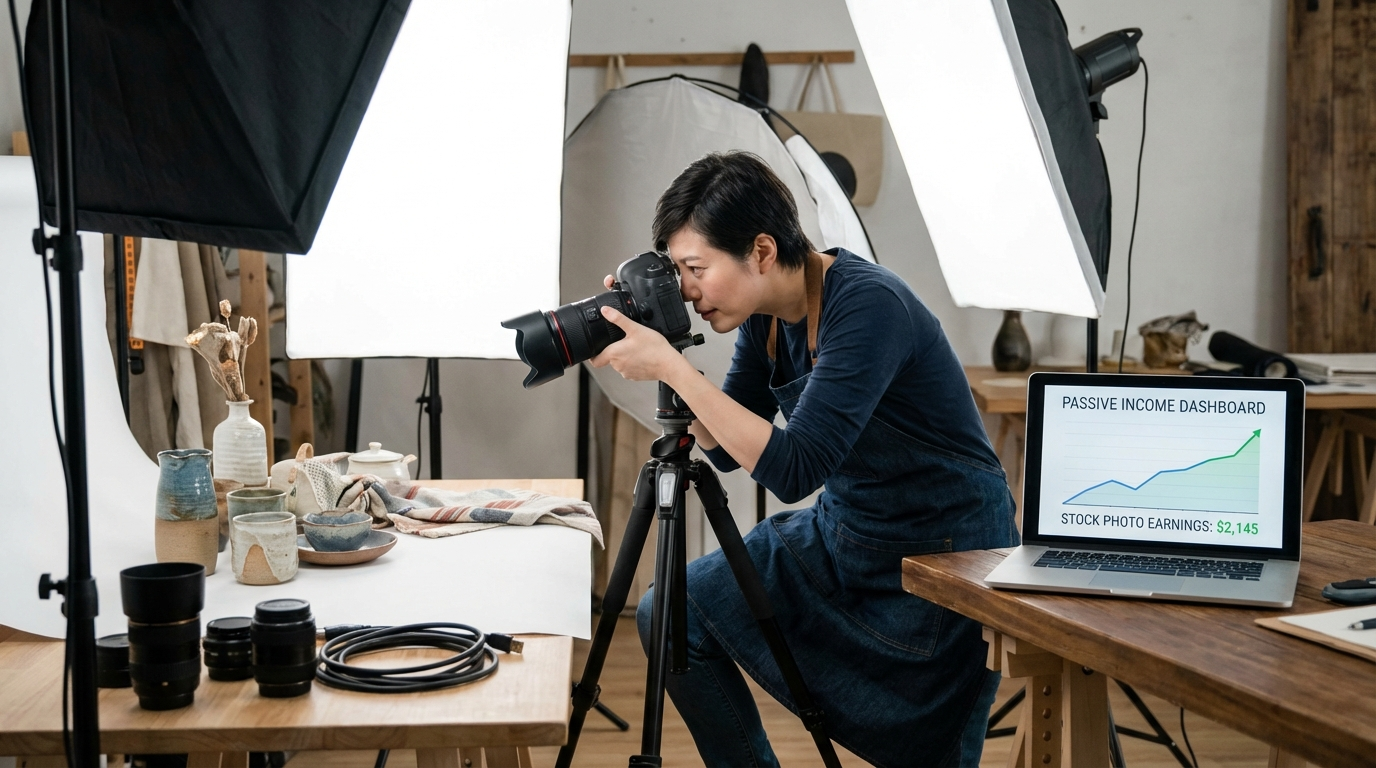
Selling stock photos and videos online is one of the genuinely passive income streams that exists in the digital economy. You shoot once, upload once, and earn royalties every time someone downloads your image — potentially for years. The global stock photography market is worth over $4 billion and growing, driven by the insatiable demand for visual content across websites, social media, ads, and publications. Here's how to build a real passive income stream from stock photography and video in 2026.
Is Stock Photography Still Worth It in 2026?
The honest answer: yes, but with caveats. The traditional "take nice photos, upload to Shutterstock, earn royalties" model still works — but the landscape has shifted. AI-generated imagery has flooded some categories, compressing prices and making it harder to stand out with generic shots.
The categories that remain valuable for human photographers:
- Real people in authentic, candid situations (AI still struggles to replicate genuine human emotion and authentic settings)
- Specific locations — local cities, regional landscapes, cultural celebrations
- Industry-specific content — healthcare, construction, trades, food preparation
- Lifestyle diversity — content featuring underrepresented communities and demographics
- Video footage — AI video is improving but still lags far behind photography in quality and authenticity
The strategy: don't compete in oversaturated categories. Find the gaps. A niche portfolio of 500 specific, high-demand images outperforms 5,000 generic ones every time.
Best Platforms to Sell Stock Photos and Videos
The major platforms each have their strengths. You should be on at least 3 simultaneously — diversifying across platforms multiplies your earning potential without multiplying your upload work.
Shutterstock
The world's largest stock photo library with 200M+ assets. High volume of downloads but relatively low per-download rates, especially at entry levels. Royalty rates start at 15% and increase as you reach higher earning tiers. For video, Shutterstock pays significantly more: $35–$99.75 per HD video download. Volume plays are the Shutterstock strategy — upload consistently and let the catalogue compound.
Adobe Stock
Adobe Stock is integrated directly into Adobe Creative Suite — Photoshop, Illustrator, Premiere — meaning buyers find your work while they're actively creating. This built-in placement is a significant advantage. Royalty rates: 33% for photos and vectors, 35% for video. Higher per-download earnings than Shutterstock at lower volume. Ideal for photographers with strong portfolio quality.
Getty Images / iStock
Getty (premium) and iStock (mid-range) are the prestige end of the market. Acceptance standards are higher, but so are earnings. Getty exclusive contributors earn 20–45% royalties on premium content. iStock non-exclusive: 15%. Getting accepted to Getty is a significant benchmark that also adds legitimacy to your portfolio for direct licensing.
Pond5
Particularly strong for video and audio. Pond5 is contributor-friendly — you set your own prices on footage. Editorial and commercial video footage earns $10–$500+ per download. If you shoot video, Pond5 is non-negotiable in your platform stack.
Alamy
Known for editorial content — news, current events, cultural images. Higher per-download rates (50% royalty on direct sales) and good demand for unique, authentic imagery. Alamy has lower traffic than Shutterstock but less competition in niche categories.
What Types of Stock Content Actually Earn
Platform choice matters, but content choice matters more. Here's what's generating consistent downloads in 2026:
Authentic Lifestyle and Business Photography
Real people working, collaborating, using technology in natural settings. Not posed corporate shots — actual-looking workday photos. Small business owners, remote workers, diverse teams, home offices. These download consistently because they're used in blog posts, website hero images, and marketing materials by businesses of every size.
Food Photography
High-quality food imagery is perennially in demand. Restaurant sites, food blogs, recipe apps, social media managers — everyone needs food content. You don't need a professional studio. Natural window light + a decent camera (or recent iPhone) + clean plating = sellable images.
Technology and AI Concepts
Abstract imagery representing AI, data, neural networks, cybersecurity, and digital concepts. High demand from tech blogs, news outlets, and SaaS companies. The challenge: these are heavily AI-generated now, so human photographers need to provide conceptual shots that AI can't easily replicate (real hardware, real settings, authentic human-technology interaction).
Nature and Travel
Still one of the most downloaded categories. Landscapes, wildlife, travel destinations. The caveat: generic beach and mountain shots are saturated. Specific locations, unusual angles, and golden-hour timing differentiate. If you travel for work or pleasure, your smartphone photos of locations others haven't uploaded are genuinely valuable.
Video Footage (B-Roll)
Video earns dramatically more per download than photos. A 15-second HD clip earns $35–$150+ depending on the platform. Drone footage, time-lapses, slow-motion people shots, and urban b-roll are consistently high-demand categories. If you have access to a drone or shoot video already, this is the highest-return content type in stock.
How Much Can You Actually Earn?
Let's set realistic expectations based on real portfolio performance:
- Small portfolio (100–300 images): $50–$200/month across 3 platforms
- Mid-size portfolio (500–1,000 images): $200–$800/month
- Large portfolio (2,000+ images/video clips): $800–$3,000+/month
- Top contributors: $5,000–$20,000+/month (typically 5,000+ diverse assets across categories)
The income grows non-linearly. Your 1,000th upload earns more per month than your 100th because established portfolios have better search rankings, more metadata history, and compound discovery. The key metric: images per month uploaded consistently. Contributors who add 50–100 images monthly typically outperform those who batch-upload thousands once and go inactive.
AI-Generated Stock: The New Frontier
Several major platforms (Adobe Stock, Shutterstock) now accept AI-generated images with specific disclosure requirements. This has created a new type of contributor: people who generate stock imagery using Midjourney, Stable Diffusion, or Gemini and upload at massive scale.
The catch: AI-generated images have specific restrictions — no real people's likenesses, no trademarked material, and you must own the model outputs. Adobe Stock requires that AI content is disclosed and the contributor certifies they have the rights to commercialise the output.
The opportunity: niche conceptual imagery that AI excels at — abstract technology concepts, fantasy environments, unique illustrated styles — can be generated in volume and uploads quickly. A contributor generating 200 AI images per month in a targeted niche can build a meaningful revenue stream faster than traditional photography allows.
Keywording: The Make-or-Break Factor
The single biggest factor in stock photography earnings isn't image quality — it's keywording. Photos that buyers can't find don't earn anything. Every image needs:
- A descriptive, keyword-rich title (not "IMG_4521" — "diverse business team video call remote work")
- 25–50 relevant keywords covering: the subject, the setting, the mood, the intended use
- Category tags that accurately reflect the image type
- Model releases (for any identifiable people) and property releases (for private buildings or distinctive interiors)
Use reverse-image search on your best-performing competitors' images to study their keyword strategies. Then apply that logic to your own uploads. Keywording is the one area where spending 20 extra minutes per batch upload compounds significantly over time.
Getting Started This Week
- Create accounts on Shutterstock, Adobe Stock, and Pond5 (takes under 1 hour)
- Review your existing photo library — you likely have 50+ sellable images already
- Upload your first 20 images with carefully written titles and keywords
- Shoot one intentional session per week targeting a specific underserved niche
- Track which categories earn most in your first 60 days — double down on those
Stock photography is a long game. The first month feels slow. By month 6, the passive income character of the model becomes real. By year 2, the catalogue works while you sleep. For more passive income strategies, check out our guide to 12 realistic passive income methods for 2026 and our coverage of selling digital products online.