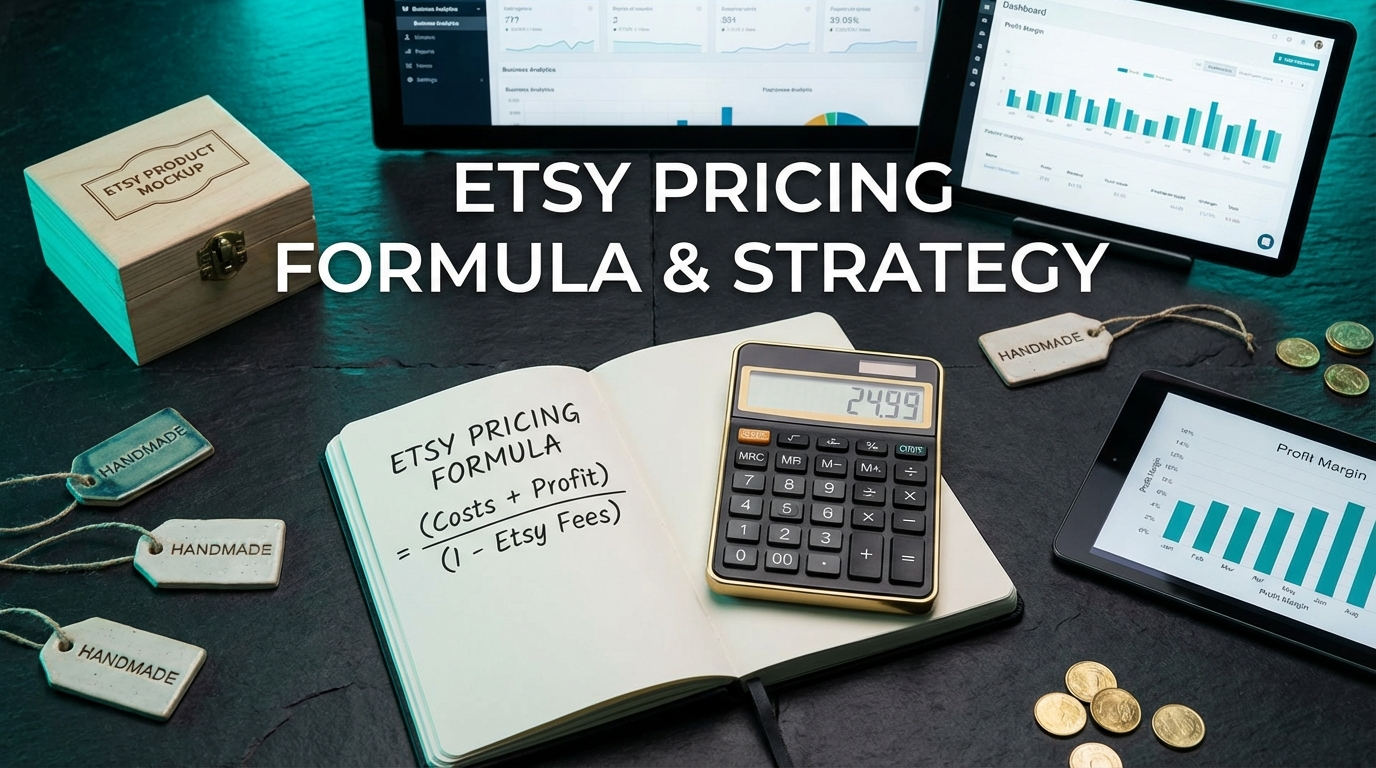
Pricing is the decision most Etsy sellers get wrong — and it kills their profitability before they even get going. Either they price too low (trying to compete on cost and destroying their margins), or they price without understanding Etsy's full fee structure and end up shocked by how little they actually keep. Here's the formula that works.
The Full Cost Stack on Etsy (What You're Actually Paying)
Before setting any price, you need to know exactly what Etsy takes from each transaction. In 2026, selling on Etsy involves these fees:
- Listing fee: $0.20 per listing, charged when published and when it renews after a sale
- Transaction fee: 6.5% of the total sale price (including shipping cost, if charged separately)
- Payment processing fee: 3% + $0.25 USD per transaction (varies slightly by country)
- Regulatory operating fee: 1.5% in some regions (UK, Europe, Australia) — check your applicable rate
- Etsy Ads (optional): CPC-based, variable
For a standard US sale, the effective fee rate is approximately 9.5-11% of the sale price, plus the $0.20 listing fee. Most sellers eyeballing a "10% fee" are close, but the details matter at scale.
The Pricing Formula
Here's the formula we use for every product:
Minimum Price = (COGS + Fixed Costs) / (1 - Target Margin %)

Where:
COGS = production cost + shipping cost (for POD)
Fixed Costs = your share of listing fees, tool subscriptions per unit
Target Margin = minimum acceptable margin (we use 40% floor)
Let's run a real example for a POD mug:
- Printify production cost: $8.50
- Printify shipping (customer pays, included in price): $5.00
- Listing fee allocation: $0.20
- COGS total: $13.70
- Target margin: 40%
- Minimum price = $13.70 / (1 - 0.40) = $13.70 / 0.60 = $22.83
After Etsy fees (~10.5% on $22.83 = $2.40), net: $22.83 - $2.40 - $13.70 = $6.73 profit — about 29% net margin on the sale price. That's acceptable for a mug.
💡 Key insight: Your target margin should be set before Etsy fees. Etsy's fees come off the top of your sale price — they're not included in your COGS. This means a "40% margin" on COGS translates to roughly 28-32% net margin after all fees. Build this in from the start.
What Most Sellers Get Wrong: Forgetting Shipping
Shipping is one of the most common pricing mistakes on Etsy. There are three approaches:
- Charge shipping separately: Customer pays shipping at checkout. You see the full product price in your listing. Downside: shipping sticker shock reduces conversion. Also, Etsy's transaction fee applies to the shipping cost too.
- Free shipping included: Build shipping cost into product price. Customer sees "FREE shipping." Etsy's algorithm favours free shipping listings in some searches. This is what we recommend.
- Hybrid: Free domestic shipping, charge international separately.
If your production cost is $8.50 and shipping is $5.00, your "free shipping" product price needs to cover both — so price it at $23.99+ rather than $18.99. The conversion improvement from "FREE shipping" typically more than compensates for the slightly higher listed price.
Competitive Pricing: Where Most Sellers Panic
New sellers see competitors pricing mugs at $14.99 and panic. They price their mugs at $14.99 too — and make almost nothing. Here's what's actually happening:
Some $14.99 mugs are loss leaders from established sellers building review volume. Some are sellers who don't understand their costs. Some are dropshippers from low-cost suppliers with different economics than Printify. The question isn't "what's the lowest price in the niche?" — it's "what's the price point where quality buyers are purchasing?"
Research method: use Everbee or manually check Etsy bestsellers in your niche. Look at the bestselling listings — not the cheapest ones. What price are the top sellers charging? In almost every POD niche, the bestsellers are priced at mid-range or above, not at the bottom.
Buyers on Etsy have a perceived value expectation for handcrafted and personalised items. A $14.99 mug feels cheap. A $24.99 mug with good mockups and reviews feels like a legitimate gift. Price below your competition's perceived value and you hurt conversion — not help it.
The Price Anchoring Strategy
Once you understand your cost floor, use anchoring to maximise perceived value and AOV (average order value):
- List your product in multiple variants at different prices (11oz mug at $22.99, 15oz mug at $26.99)
- Bundle products (mug + coaster set at $34.99 — feels like a deal vs buying both separately)
- List a premium version at 30-40% above your standard price — makes the standard version look like the sensible choice
The goal isn't to sell the most of the cheapest thing — it's to maximise revenue per transaction. Getting a customer to buy a $27 mug instead of a $22 mug on the same transaction increases your revenue 22% with zero additional effort.
When to Raise Your Prices
These are signals you're priced too low:
- Consistent 5-star reviews with no complaints about price
- You're selling out (unusual for POD, but can happen for digital products)
- Conversion rate is extremely high (above 3-4% consistently) — you may be leaving money on the table
- Customers are buying without asking questions or negotiating
Raise prices by 10-15% and monitor conversion rate for 2-3 weeks. If conversion drops significantly, test a middle point. If conversion stays stable, you've found a better equilibrium. Many sellers discover their "maximum" price is significantly higher than where they started.
Pricing Digital Products
Digital products follow different psychology than physical goods. Price anchors are harder to establish, but the margin flexibility is enormous. Principles:
- Don't price under $3.99 — very low prices signal low quality and attract refund-seekers
- Bundles convert better — a $14.99 bundle of 5 related digital files often outsells 5 x $3.99 items
- Perceived work = price — a 20-page planner should cost more than a single page, even if digital creation time was similar
- Test $9.99, $12.99, and $14.99 — the difference in conversion is often small, but the revenue difference is significant
The Practical Pricing Checklist
- Calculate your full COGS (production + shipping for POD)
- Set a minimum margin floor (we use 40% on COGS)
- Apply the formula to get your minimum viable price
- Check competitor bestsellers — find the top 5 and note their price range
- Position at the mid-point of that range, or slightly above with better mockups/branding
- Include shipping in the listed price where possible
- Review after 30 days — if you're not selling, the issue is rarely price. Check your images and SEO first.
Pricing is something you'll refine over time as you learn your niche. But starting with a formula — rather than guessing — means you're at least profitable from day one while you gather data.
See What Competitors Are Charging
Everbee shows estimated revenue and pricing on any Etsy listing. Free to start.
Try Everbee Free →